

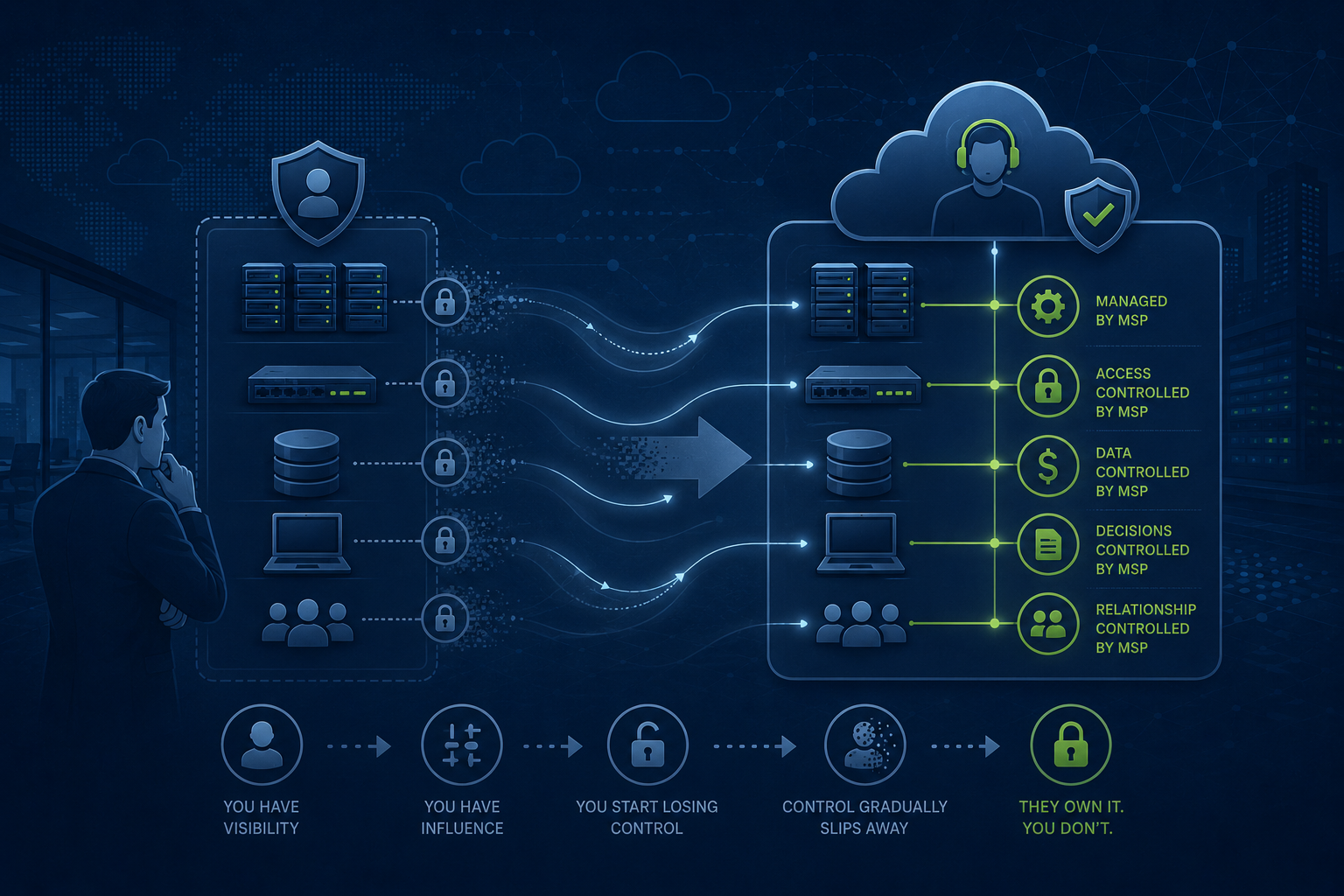
Many small businesses hire an MSP expecting simplicity. Someone else manages the technology, handles updates, and provides support when problems occur.
Unfortunately, some MSP relationships create a different problem: the business gradually loses control of its own infrastructure.
Over time, the MSP becomes the owner of the critical systems that the business depends on. They control the Microsoft tenant, DNS records, backups, firewall management, cloud storage, documentation, administrative accounts, and sometimes even the business domain itself.
Everything works—until the business wants to make a change.
The Hidden Cost of Convenience
Vendor lock-in is often discussed in software, but it can also happen in managed services.
When infrastructure is built around proprietary tools, undocumented configurations, or accounts controlled by a third party, changing providers becomes difficult and expensive.
The business may discover that:
- Administrative access is unavailable
- Documentation is incomplete
- Backup procedures are unclear
- Service configurations cannot easily be transferred
- Migration costs are unexpectedly high
The result is a relationship that is difficult to leave, even when the service no longer meets expectations.
Ownership Should Survive the Provider
Technology providers should make infrastructure easier to operate, not harder to own.
A healthy IT relationship allows the business to:
- Maintain ownership of data
- Control administrative access
- Retain documentation
- Understand where critical services live
- Transition providers without disruption
In other words, the infrastructure should belong to the business, regardless of who manages it.
The FOSSnix IT Perspective
At FOSSnix IT, infrastructure is designed around ownership first.
Clients retain control of their systems, data, documentation, and administrative access. Ongoing management is available, but dependency is never the objective.
Technology should create operational freedom, not operational captivity.