
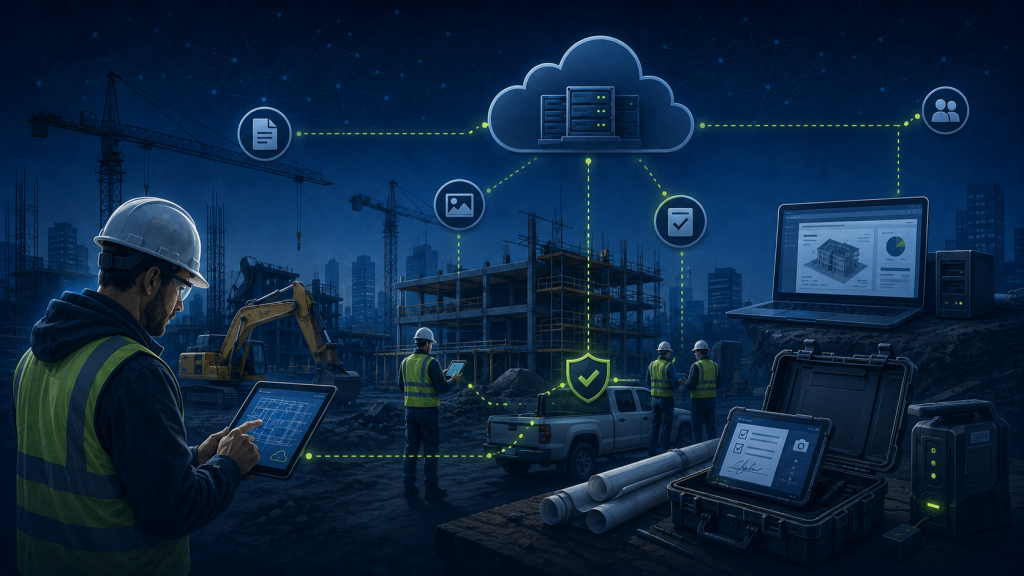
Construction work does not happen behind a desk.
Project managers move between job sites. Estimators work from the field. Owners travel between clients, suppliers, and active projects. Subcontractors need access to current drawings and documentation from wherever work is taking place.
The challenge is making information available when it’s needed without sacrificing security or reliability.
For many construction firms, secure remote access has become a core part of daily operations.
The Job Site Depends on Information
Modern construction projects generate a significant amount of digital information.
Teams often rely on:
- Drawings and plans
- Contracts and change orders
- Project documentation
- Photos and site reports
- Financial records
- Vendor and subcontractor information
When the latest version of a document is unavailable, mistakes become more likely.
Delays, rework, and communication problems often follow.
Reliable access to project information is no longer a convenience. It is part of operational efficiency.
Consumer Remote Access Solutions Create Risk
Many businesses begin with simple solutions.
Documents may be shared through email, consumer cloud accounts, or remote desktop tools configured with minimal planning.
These approaches often work initially but become difficult to manage as projects and personnel increase.
Common problems include:
- Uncontrolled file sharing
- Outdated document versions
- Weak authentication
- Lack of visibility
- Difficulty removing access when personnel change
What starts as a convenience can eventually become a security and operational challenge.
Secure Access Should Be Simple
Good infrastructure balances security with usability.
Field personnel should not need complicated procedures to access project information.
A well-designed remote access environment typically includes:
- Secure VPN connectivity
- Multi-factor authentication
- Centralized file storage
- Role-based access controls
- Mobile device compatibility
- Encrypted communications
The goal is straightforward:
Authorized users can access what they need while unauthorized users cannot.
Connectivity Is Not Always Predictable
Construction projects often take place in environments where internet access is limited or unreliable.
This makes infrastructure planning especially important.
Organizations should consider:
- Offline document availability
- Automatic synchronization
- Local caching
- Backup communication methods
- Data recovery procedures
Access strategies should account for real-world conditions rather than ideal conditions.
Security Supports Continuity
Many construction firms think of security as protection against cyber threats.
While that matters, security also supports continuity.
A secure and well-managed infrastructure helps prevent:
- Unauthorized access
- Lost project information
- Accidental data exposure
- Operational disruptions
- Recovery challenges after equipment failures
The result is a more reliable environment for both office and field personnel.
The FOSSnix IT Perspective
Construction firms succeed when the right people have access to the right information at the right time.
Secure remote access should help teams work more effectively, not create obstacles.
The best infrastructure allows project teams to stay connected to critical information whether they are in the office, on a job site, or traveling between projects.