

Explore IT Migration Scenarios
Transitioning your IT environment doesn’t have to be disruptive.
This page outlines how businesses move from subscription-based platforms to Linux-based, open infrastructure using a structured, phased approach. Instead of replacing everything at once, systems are migrated gradually—keeping your operations running while reducing vendor lock-in and long-term costs.
Explore Several IT Migration and Rebuild Scenarios
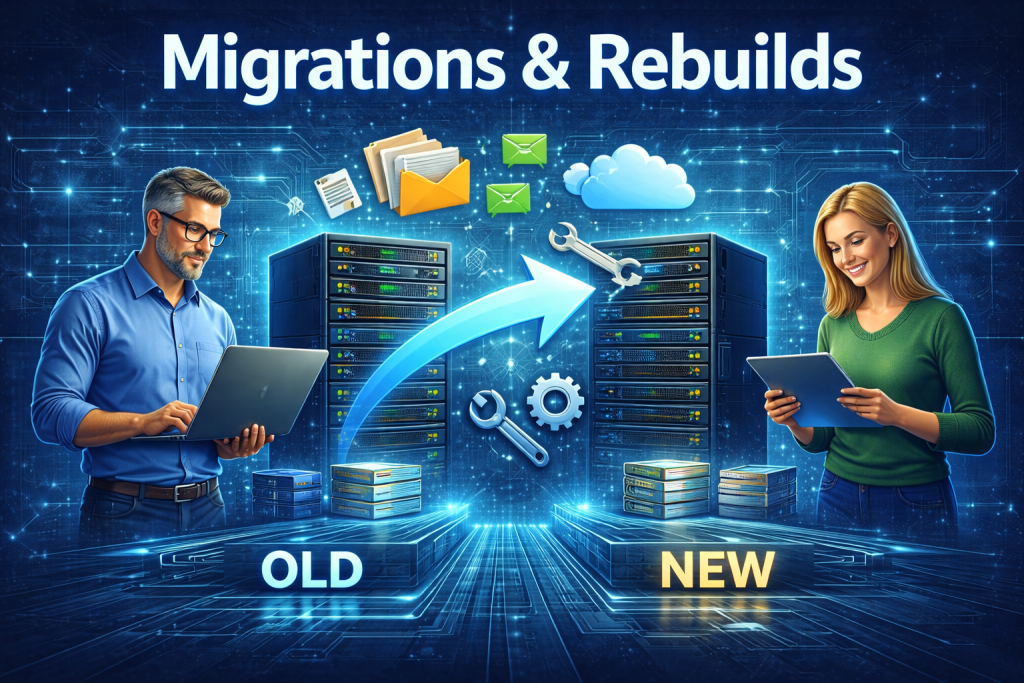
Most organizations don’t start with a clean slate. Over time, they accumulate a mix of SaaS subscriptions, cloud services, and vendor-controlled platforms—each adding cost, complexity, and dependency.
FOSSnix IT helps businesses transition toward infrastructure they own and control, built on open platforms and standard technologies. Instead of disruptive “rip-and-replace” projects, systems are migrated in phases—keeping operations stable while reducing long-term costs and vendor lock-in.
The examples below illustrate common migration paths and how environments can evolve without interrupting day-to-day business.
Leaving Microsoft 365
The Situation
A small organization relies heavily on Microsoft 365 for email, file storage, collaboration, and identity management.
Typical services include:
- Microsoft 365 Business Premium licenses
- OneDrive for file storage
- SharePoint document libraries
- Teams for internal communication
- Exchange Online email
While convenient initially, subscription costs continue to grow as the team expands.
Migration Approach
FOSSnix IT replaces the subscription-based platform with a self-hosted collaboration stack.
Typical replacements include:
| Existing Platform | Replacement |
|---|---|
| Microsoft Exchange Online | Hosted email with Postfix/Dovecot |
| OneDrive / SharePoint | Nextcloud |
| Microsoft Teams | Element / Matrix |
| Azure AD identity reliance | Local infrastructure identity management |
Users continue to access familiar capabilities—email, shared files, messaging—but the systems now operate on infrastructure owned by the organization.
Outcome
The organization moves from per-user subscription licensing to a system built on infrastructure that scales with the business.
Benefits include:
- predictable infrastructure costs
- long-term ownership of systems and data
- independence from vendor licensing changes
- simplified long-term IT planning
Consolidating Multiple SaaS Tools
The Situation
A growing team relies on a variety of SaaS platforms:
- Google Workspace for email
- Dropbox for file sharing
- Slack for messaging
- Zoom for meetings
- A password manager subscription
- Various workflow and productivity tools
Each service is useful individually, but the combined subscriptions become difficult to track and expensive over time.
Migration Approach
FOSSnix IT consolidates several functions into a unified infrastructure platform.
Typical replacements include:
| Existing Service | Replacement |
|---|---|
| Google Workspace | Hosted email + collaboration stack |
| Dropbox | Nextcloud file storage |
| Slack | Matrix / Element messaging |
| Zoom | Jitsi video conferencing |
| SaaS password manager | Vaultwarden |
By consolidating capabilities into fewer platforms, the organization reduces operational complexity and recurring subscriptions.
Outcome
The result is a simpler environment with fewer moving parts.
Organizations gain:
- fewer vendor relationships
- reduced subscription overhead
- centralized infrastructure management
- better control over data location and retention
Rebuilding Aging Infrastructure
The Situation
Some organizations still operate legacy on-premise infrastructure built years ago:
- aging Windows Server systems
- unsupported software versions
- fragmented backups
- undocumented network architecture
In many cases the organization considers moving entirely to SaaS platforms because rebuilding the infrastructure seems complex.
Migration Approach
FOSSnix IT modernizes the environment using open infrastructure platforms designed for longevity.
Typical components include:
- Proxmox virtualization platform
- Linux-based infrastructure services
- Nextcloud collaboration platform
- automated backup and monitoring systems
- documented network architecture
Rather than abandoning ownership, the organization rebuilds its infrastructure on modern systems designed for long-term maintainability.
Outcome
The business retains control over its infrastructure while gaining the benefits of modern platforms:
- improved reliability
- modern security practices
- better system visibility
- documented infrastructure for long-term support
What All Migration Scenarios Have in Common
Assessment
Review existing systems, subscriptions, and dependencies.
Architecture Design
Design an infrastructure that supports the organization’s actual operational needs.
Gradual Transition
Move services in phases to avoid operational disruption.
Documentation & Support
Every environment includes documentation and long-term operational support.
Considering a Migration?
Many organizations are surprised how much of their IT spending is tied to recurring subscriptions. A structured migration can often reduce long-term costs while improving control over infrastructure.
Start a Conversation
See if We’re a Good Fit