Nextcloud vs Microsoft 365
Own Your Collaboration Platform
Own Your Collaboration Platform
Stop renting your business operations. Build collaboration infrastructure you actually control.
Microsoft 365 bundles email, file storage, collaboration, and identity into a subscription model where your data—and your costs—are tied to a vendor ecosystem.
Nextcloud replaces those same core capabilities with an open, self-hosted platform you own.
What Nextcloud Replaces
| Microsoft 365 Component | Nextcloud Equivalent | What It Means for You |
|---|---|---|
| OneDrive | Nextcloud Files | Private file storage under your control |
| SharePoint | Nextcloud Teams / Shared Folders | Structured collaboration without vendor lock-in |
| Teams (chat) | Nextcloud Talk | Internal messaging, voice, and video |
| Office Online | OnlyOffice / Collabora | Browser-based document editing |
| Outlook (calendar/contacts) | Nextcloud Groupware | Fully integrated scheduling + contacts |
| Power Automate (basic workflows) | Nextcloud Flow | Lightweight automation without licensing tiers |
Nextcloud Core Capabilities
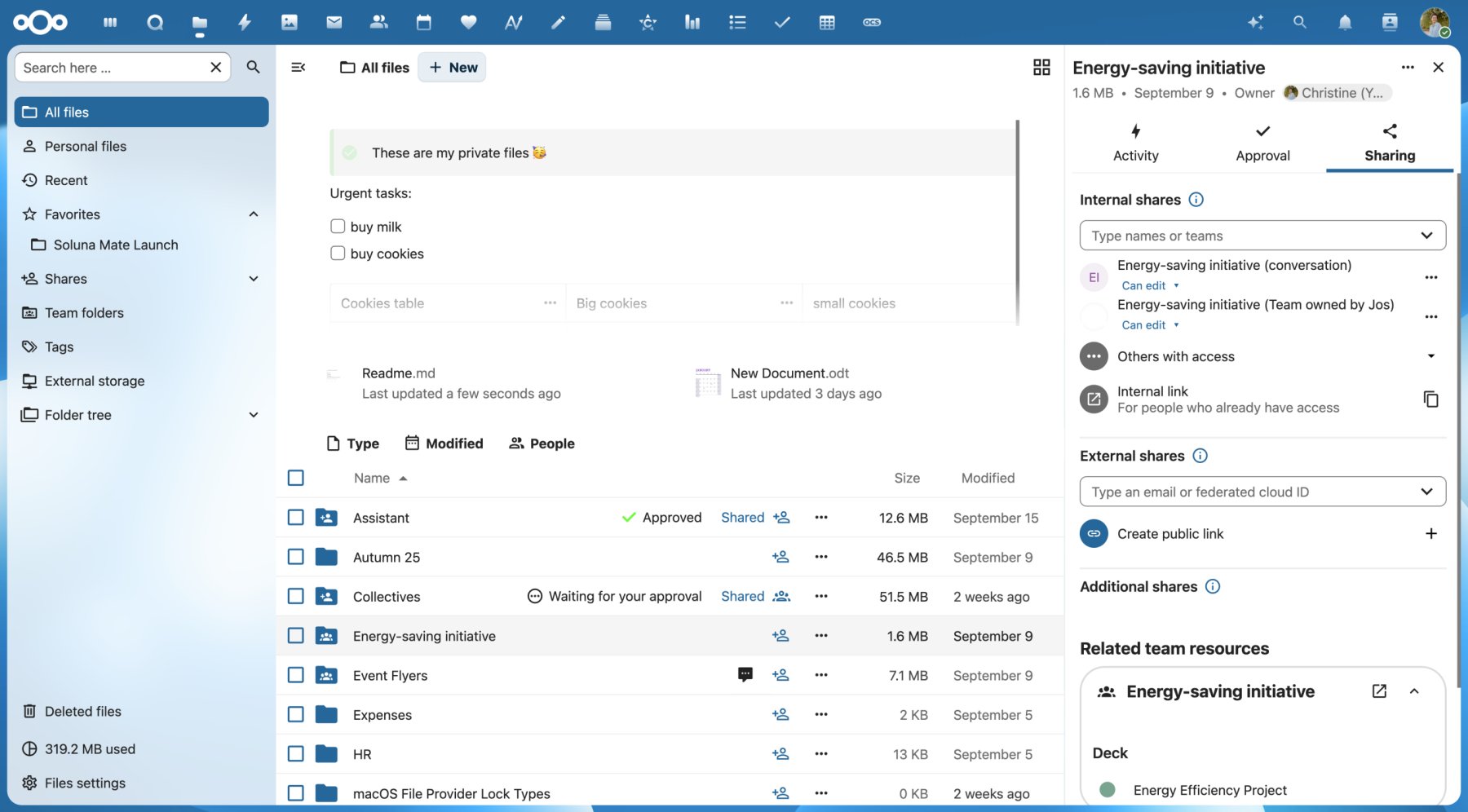
Private File Storage & Sharing
- File sync across desktop and mobile devices
- Secure sharing with internal and external users
- Versioning and recovery built-in
- No third-party data mining or scanning
Real-Time Document Collaboration
- Browser-based editing (Word, Excel, PowerPoint equivalents)
- Multi-user real-time collaboration
- Full document ownership and storage control
- Choose your editor: OnlyOffice or Collabora
Chat, Voice, and Video
- Internal messaging and group chat
- Video meetings and screen sharing
- No per-user meeting licensing
- Runs entirely within your infrastructure
Calendar, Contacts, and Scheduling
- Shared calendars and resource scheduling
- Contact management across teams
- Sync with mobile devices (iOS/Android)
- Standards-based (CalDAV/CardDAV)