

One of the most important infrastructure projects I’ve completed wasn’t deploying a new application or server.
It was creating a standardized Cloud-Init template.
On the surface, that might sound like an internal technical exercise. In reality, it changes how every future virtual machine is deployed, maintained, and supported.
It makes infrastructure repeatable.
Every Manual Build Is Slightly Different
When servers are built by hand, small differences inevitably creep in.
- Maybe one machine has the wrong time zone
- Another is missing the guest agent
- A third has a different SSH configuration
- Someone forgot to update packages
- Another administrator used a different naming convention
None of these issues seem significant until months later when troubleshooting becomes more difficult because every server is unique.
Consistency matters.
A Cloud-Init Template Creates a Known Baseline
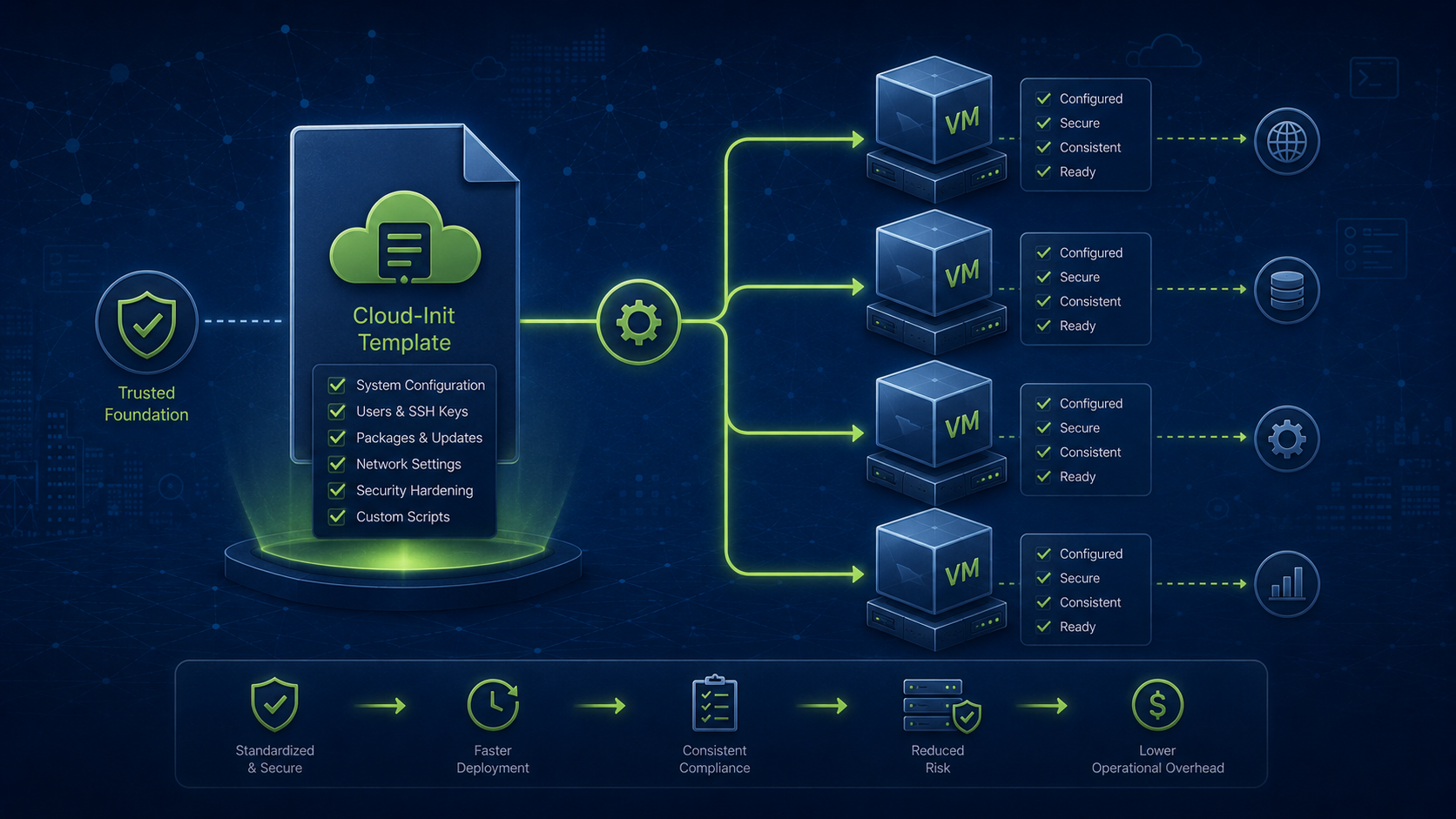
A Cloud-Init template allows every new virtual machine to begin from the same trusted foundation.
That trusted foundation is used to deploy the infrastructure that modern businesses rely on every day, including:
- Private file storage and collaboration
- Knowledge bases and internal documentation
- Customer support and ticket management
- Infrastructure monitoring and operational visibility
- Automated backup and disaster recovery
- Secure remote access for employees and contractors
- Business-critical web applicationsIdentity and access management
- Development and testing environments
- Future services that haven’t been imagined yet
Infrastructure Becomes Repeatable
One of the goals at FOSSnix IT is to eliminate unnecessary variability.
When every server starts from the same template:
- Deployments become faster.
- Documentation becomes simpler.
- Troubleshooting becomes easier.
- Automation becomes practical.
- Security becomes more consistent.
The template becomes part of the platform rather than an afterthought.
Better Foundations Enable Better Automation
Cloud-Init is often associated with speed, but speed is only part of the benefit.
The bigger advantage is automation.
When networking, hostnames, user accounts, SSH keys, and storage can all be configured automatically during deployment, administrators spend less time repeating routine tasks and more time building valuable services.
Automation reduces both effort and opportunities for human error.
Standardization Improves Security
Security is easier when systems are predictable.
A standardized deployment process makes it easier to verify that:
- The correct packages are installed.
- The guest agent is running.
- SSH access follows policy.
- Disk layouts are consistent.
- Updates have been applied.
- Configuration drift is minimized.
Every server starts from a trusted baseline instead of relying on memory or handwritten checklists.
It’s an Investment That Pays Dividends
Creating the first template takes time.
Testing it takes more time.
Verifying Cloud-Init behavior, networking, storage expansion, and guest integration requires patience.
But every deployment after that benefits from the work.
Instead of spending an hour building another Ubuntu VM, the process becomes cloning a template and supplying a few deployment-specific values.
The cumulative time savings are substantial.
The FOSSnix IT Perspective
Good infrastructure isn’t defined by how quickly servers can be created.
It’s defined by how consistently they can be recreated.
A Cloud-Init template transforms virtual machine deployment from a manual process into a repeatable standard.
That consistency improves security, documentation, automation, and operational confidence.
In many ways, the template itself becomes part of the infrastructure.
And for a business that depends on reliable systems, that’s exactly where it belongs.