

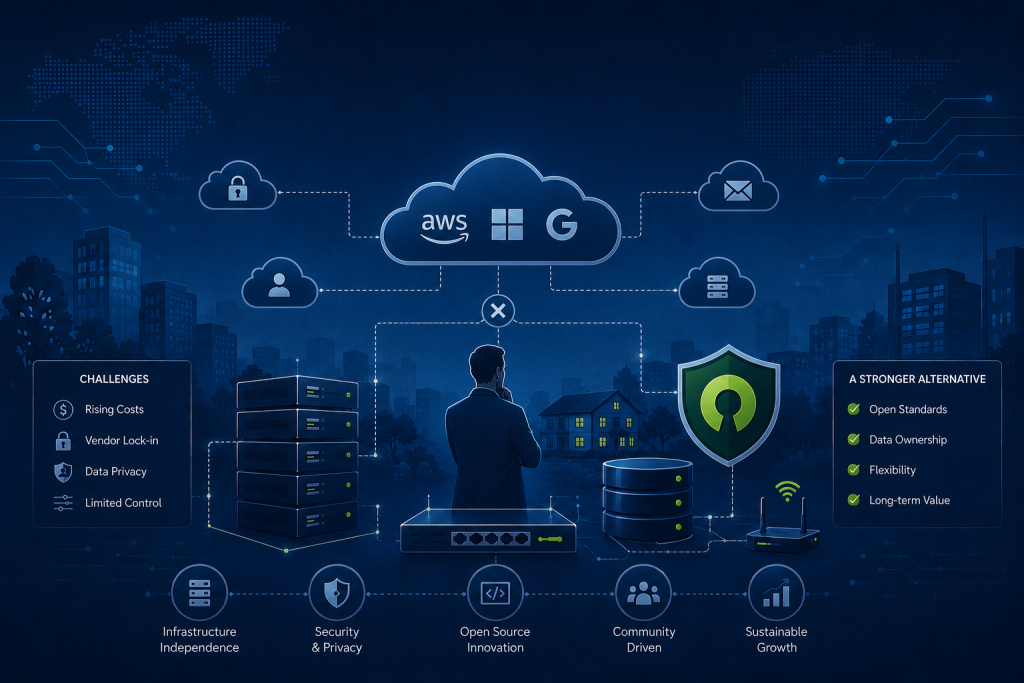
A recent post from Nextcloud highlighted a growing conversation around digital sovereignty and technology dependence. According to a Bitkom report referenced in the article, relatively few organizations have formally analyzed their digital dependencies or taken steps to reduce them.
That finding caught my attention because this trend is one of the reasons I started FOSSnix IT.
The Question More Organizations
Are Starting to Ask
For the last decade or so, the default path for many organizations has been straightforward: subscribe to a cloud service, move files into a vendor ecosystem, and let someone else manage the platform.
There are certainly benefits to that approach. Cloud platforms can be convenient, scalable, and easy to adopt.
But over time, many organizations discover that convenience comes with tradeoffs.
Questions begin to surface:
- What happens if prices increase?
- How difficult would it be to move elsewhere?
- Where is our data actually stored?
- Who controls access to our information?
- How dependent are we on a single vendor’s roadmap and business decisions?
These aren’t necessarily reasons to abandon cloud services. They are simply important questions that deserve thoughtful answers.
The Inspiration Behind FOSSnix IT
When I started building FOSSnix IT, I wasn’t trying to create a business that was anti-cloud or anti-Microsoft.
The vision was much simpler.
I wanted to help organizations understand that they have choices.
Many business owners assume the only path forward is an ever-growing collection of subscriptions tied to a handful of large vendors. In reality, there are often alternative approaches built on open standards, open-source software, and infrastructure that organizations can directly control.
That belief eventually became the foundation of FOSSnix IT’s Data Ownership First approach. The idea is straightforward: organizations should understand where their data lives, who controls it, and what options they have if they ever decide to change providers or platforms.
The goal isn’t to eliminate every subscription. The goal is to avoid unnecessary dependence and preserve flexibility for the future.
Ownership Changes the Conversation
One of the themes I discuss frequently with clients is ownership.
When an organization owns its infrastructure, documentation, backups, and data, it gains options.
It can change service providers more easily.
It can adapt technology as business needs evolve.
It can make decisions based on operational requirements rather than vendor limitations.
Ownership doesn’t solve every problem, but it often provides a level of control that many organizations don’t realize they’ve lost until they need it. This is one of the reasons I frequently discuss Why Ownership Matters when evaluating technology decisions. The ability to maintain control over critical business systems can have long-term operational and financial benefits.
Open Standards Create Flexibility
One misconception I often encounter is that organizations must choose between large commercial platforms and building everything themselves.
Fortunately, there is a lot of middle ground.
Modern Open-Source Infrastructure can provide practical alternatives for file sharing, collaboration, backup, monitoring, and remote access while still supporting the tools and workflows businesses rely on every day.
Open standards also make future changes easier. Even if an organization never leaves its current platform, maintaining flexibility can reduce risk and improve negotiating leverage over time.
The objective is not to chase technology trends. It’s to build systems that remain useful, maintainable, and adaptable for years to come.
Why This Matters for Small Organizations
Large enterprises and government agencies often have teams dedicated to evaluating technology risk, vendor relationships, and long-term platform strategy.
Small organizations rarely have that luxury.
Business owners are focused on serving customers, managing employees, and growing their operations. Technology decisions are often made based on immediate needs rather than long-term consequences.
That’s completely understandable.
But even small organizations benefit from asking a few strategic questions:
- Do we have access to our own data?
- Can we migrate if we choose to?
- Are our backups independent of the platform we use every day?
- Do we understand the long-term costs of our technology stack?
Those conversations can have a significant impact on future flexibility and resilience.
The FOSSnix IT Perspective
The growing interest in digital sovereignty isn’t just a government issue or an enterprise issue.
It’s really a conversation about control, flexibility, and long-term sustainability.
Every organization will arrive at different answers based on its needs and priorities. Some will continue using commercial cloud platforms. Others will explore open-source alternatives. Many will choose a combination of both.
What’s important is understanding the options and making deliberate decisions rather than assuming there is only one path forward.
That idea—the belief that organizations should have meaningful choices about their technology—is what inspired FOSSnix IT from the beginning, and it’s a conversation I expect we’ll continue to see grow in the years ahead.
If you’re unsure how dependent your organization is on a particular vendor ecosystem, an Infrastructure Review can help identify opportunities to improve resilience, flexibility, and long-term control before those dependencies become business risks.
Source: Nextcloud’s recent LinkedIn article on migration planning and digital sovereignty.