

Why Ownership Matters
FOSSnix delivers practical, ownership-first systems for networking, storage, backups, and remote access—built specifically for small offices that need reliability without enterprise complexity.
Small Businesses Are Increasingly Renting Their Entire Operations
Many businesses today run on software subscriptions they do not control.
Email is rented. File storage is rented. Passwords, documents, accounting files, internal chat, backups, and even customer communications often live entirely inside someone else’s cloud platform.
For many businesses, this happened gradually. A Google Workspace account here. A Microsoft 365 subscription there. A Dropbox folder. A SaaS invoicing tool. Another monthly subscription for backups. Another for remote access. Another for project management.
Individually, each tool seems inexpensive.
Collectively, they create a business that depends entirely on outside vendors to continue operating.
Micro organizations are especially vulnerable to this because they usually do not have internal IT staff, procurement teams, or infrastructure planning. Technology decisions get made reactively, one subscription at a time, until the business becomes operationally dependent on platforms it does not own.
That dependency has consequences.
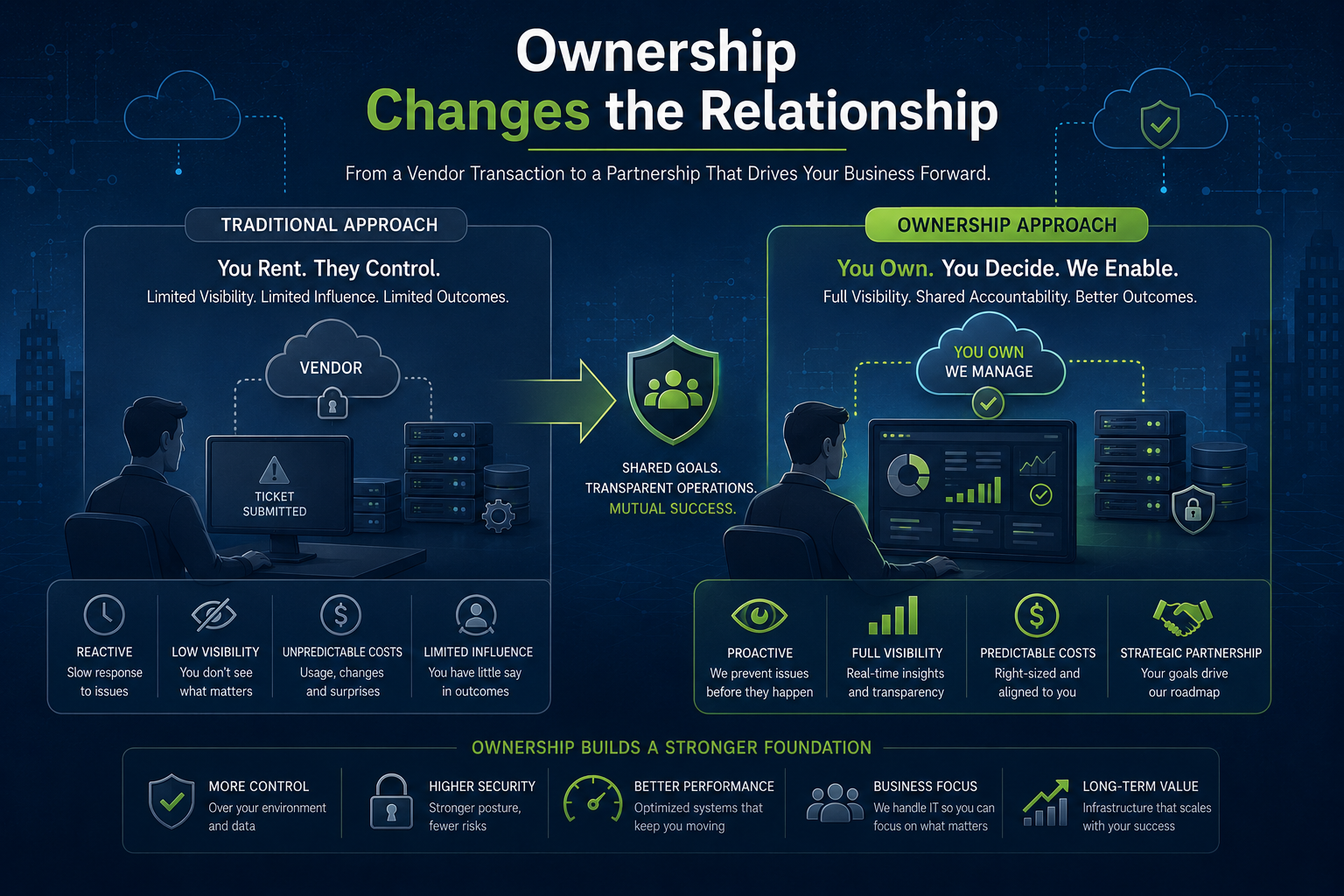
Ownership Changes the Relationship
At FOSSnix IT, the goal is not simply to “provide IT support.”
The goal is to help small organizations build infrastructure they actually control.
That means:
- Your files live on systems you own
- Your backups belong to you
- Your operational data remains portable
- Your infrastructure continues functioning even if a vendor changes pricing, terms, or product direction
- Your business is not forced into endless subscription escalation just to continue operating normally
Ownership-first infrastructure does not mean “anti-cloud.”
It means the cloud becomes a tool — not your landlord.
Why This Matters Specifically for Micro Businesses
Large enterprises can absorb vendor lock-in costs.
Micro organizations usually cannot.
A 5-person office losing access to shared files for even a single day can halt operations completely. Unexpected SaaS price increases impact smaller companies disproportionately because technology costs consume a larger percentage of operating revenue.
Micro businesses also tend to accumulate “shadow IT” faster:
- personal Dropbox accounts
- unmanaged Google Drives
- USB hard drives used as backups
- passwords stored in browsers
- employee-owned SaaS accounts
- no centralized documentation
- no recovery process
Eventually, the business reaches a point where nobody fully understands where critical operational data actually lives.
That is not a software problem.
It is an infrastructure ownership problem.
The Hidden Cost of “Cheap” SaaS
Most subscription platforms are marketed around convenience.
Very few are marketed around long-term operational control.
What begins as a $12/month user subscription often expands into:
- recurring storage upgrades
- advanced security licensing
- retention add-ons
- backup subscriptions for the SaaS platform itself
- additional identity services
- compliance requirements
- vendor ecosystem lock-in
Over several years, many small organizations end up paying enterprise-style recurring costs without receiving enterprise-level control.
The result is often:
- higher long-term spend
- fragmented systems
- duplicated services
- operational dependency
- limited portability
Micro businesses frequently discover this only after trying to migrate away.
Ownership-First Infrastructure
Looks Different
An ownership-first environment is built around durability and operational continuity.
Instead of asking:
“What app should we subscribe to?”
The better question becomes:
“What systems does this business need to operate reliably for the next 5–10 years?”
For many micro organizations, that means:
- local infrastructure where appropriate
- centralized storage
- properly structured backups
- secure remote access
- standardized user management
- documented systems
- Linux and open-source platforms where practical
- fewer overlapping subscriptions
- infrastructure sized to the business instead of enterprise bloat
This is the philosophy behind how FOSSnix IT designs environments for small operators.
Ownership Does Not Mean Complexity
One of the biggest misconceptions about self-hosted or ownership-first infrastructure is that it must be complicated.
It does not.
Micro businesses do not need miniature enterprise data centers.
They need:
- reliable systems
- sensible redundancy
- secure remote access
- clear documentation
- stable operations
- predictable costs
The objective is not to maximize technical sophistication.
The objective is to reduce operational fragility.
What FOSSnix IT Focuses On
FOSSnix IT works specifically with organizations that want a more grounded, infrastructure-first approach to business technology.
That includes:
- small offices
- independent operators
- local service businesses
- small professional firms
- creative studios
- trades and field offices
- nonprofits
- owner-operated businesses
The focus is on:
- practical infrastructure
- ownership-first design
- Linux and open-source systems
- operational resilience
- reducing vendor dependency
- building environments that can evolve over time
Not every business needs this approach.
But for organizations that value stability, control, portability, and long-term operational ownership, it matters.
The Goal is Operational Independence
Technology should support the business — not trap it.
Ownership-first infrastructure is ultimately about reducing dependency and increasing operational resilience.
For micro organizations, that can mean:
- fewer recurring platforms
- simpler recovery processes
- better visibility into systems
- lower long-term infrastructure costs
- reduced vendor exposure
- improved continuity during outages or disruptions
- infrastructure that remains understandable years later
Small businesses deserve infrastructure designed around their actual operational needs — not infrastructure optimized primarily for recurring subscription extraction.
That is the philosophy behind FOSSnix IT.
Build Infrastructure You Actually Control
Whether you are starting fresh, cleaning up years of scattered SaaS tools, or trying to regain visibility into your business systems, the first step is understanding where your operational dependencies currently exist.
Learn what Data Ownership First means