

What Determines Your Micro Business
IT Infrastructure Investment
Every organization operates differently, which means infrastructure requirements — and investment levels — can vary significantly even among similarly sized businesses.
Factors such as data ownership goals, backup retention needs, remote work requirements, security hardening, monitoring, documentation, and long-term operational independence all influence the overall scope of a deployment.
Infrastructure Sized for Micro Businesses
Most micro businesses do not need a server room, full-time IT department, or expensive enterprise subscriptions. But they do need stable infrastructure, secure data storage, reliable backups, and systems that won’t collapse the moment something breaks.
At FOSSnix IT, investment is based on the actual operational complexity of your business — not arbitrary licensing tiers or inflated “small business package” pricing.
A solo accountant working from a home office has very different infrastructure requirements than a 10-person design studio managing shared project storage and remote access. The goal is to right-size the environment so you get reliable infrastructure without paying for systems you’ll never use.
The Four Things That Most Affect Cost
1. How Dependent You Are on Shared Data
The more your organization relies on centralized files, collaboration, shared applications, or synchronized workflows, the more important proper infrastructure becomes.
Simple examples:
- One person working mostly locally
- Light cloud file usage
- Minimal shared storage
More advanced examples:
- Shared project folders
- Multi-user document access
- Centralized file servers
- Department data organization
- Permissions and audit requirements
As shared data becomes operationally important, infrastructure requirements increase:
- Storage reliability
- Backup systems
- User permissions
- Network throughput
- Recovery planning
2. Remote Access & Mobility Requirements
A business operating entirely from one location is simpler than one requiring:
- Remote work access
- VPN connectivity
- Multi-device synchronization
- Secure external access
- Mobile workforce support
Remote access introduces additional infrastructure considerations:
- Identity management
- Secure networking
- Access control
- Encryption
- Authentication systems
- Internet reliability planning
Micro organizations often underestimate how much operational risk exists in “just exposing files remotely.”
3. Storage Capacity & Retention
Storage requirements dramatically influence hardware sizing and backup strategy.
This includes:
- Current data volume
- Expected growth
- Backup retention requirements
- Large media/project files
- Long-term archival needs
A bookkeeping office storing PDFs has very different storage demands than:
- Video creators
- Architecture firms
- Engineering offices
- Photography studios
- CAD environments
Larger datasets require:
- More resilient storage layouts
- Faster disks
- Additional backup capacity
- Expanded recovery planning
4. Operational Continuity Expectations
Some micro businesses can tolerate downtime.
Others cannot.
A temporary outage may be inconvenient for one organization but operationally catastrophic for another.
Continuity expectations affect:
- Hardware redundancy
- Backup frequency
- Monitoring systems
- Recovery procedures
- Spare hardware planning
- UPS and power protection sizing
Organizations that rely heavily on uptime generally invest more upfront to reduce future operational disruption.
What Doesn’t Determine Pricing
Many vendors charge primarily based on:
- User count
- Device count
- SaaS subscriptions
- Feature gating
That model often breaks down for micro businesses because:
- A 3-person company may still require serious infrastructure
- A 15-person office may operate very simply
- Subscription costs compound rapidly over time
We Don’t Price Around Arbitrary License Counts
FOSSnix IT instead focuses on:
- Operational requirements
- Infrastructure complexity
- Data importance
- Recovery expectations
- Long-term maintainability
Common Micro Business Scenarios
Solo Professional / Operator
Examples:
- Consultants
- Bookkeepers
- Therapists
- Independent brokers
- Small legal practices
Typical needs:
- Secure file storage
- Backup protection
- Basic remote access
- Identity and password management
- Reliable networking
These environments are usually designed around simplicity, ownership, and low operational overhead.
Small Collaborative Team
Examples:
- Creative studios
- Small agencies
- Construction offices
- Small medical/wellness teams
- Property management offices
Typical additions:
- Shared project storage
- Centralized permissions
- Multi-user collaboration
- Expanded backup retention
- Higher uptime expectations
These deployments typically require more structured infrastructure planning.
Operationally Critical
Micro-Business
Examples:
- Businesses dependent on shared operational systems
- Organizations with compliance sensitivity
- Teams with constant remote access requirements
- Offices with large active datasets
These environments may justify:
- Redundant systems
- Advanced backup validation
- Segmented networking
- Dedicated infrastructure hardware
- Continuous monitoring
Even with a small headcount, operational dependence can justify more robust infrastructure.
Ownership Changes the Economics
Subscription-heavy ecosystems often appear inexpensive initially because infrastructure costs are hidden behind recurring monthly fees.
Ownership-first infrastructure works differently.
You invest in:
- Hardware you control
- Systems that remain operational without subscription lock-in
- Infrastructure sized for your actual workload
- Long-term operational stability
The result is typically:
- Lower long-term software dependency
- More predictable operational costs
- Greater control over business data
- Reduced vendor lock-in
Typical Investment Categories
Foundation Infrastructure
One-time project investment covering:
- Infrastructure design
- Hardware deployment
- Network configuration
- Storage setup
- Backup systems
- Secure remote access
- Documentation and validation
This is the “build your foundation” phase.
Ongoing Infrastructure Management
Optional recurring management services may include:
- System monitoring
- Patch management
- Backup verification
- Security maintenance
- Infrastructure administration
- Capacity review
- Operational support
This keeps the environment healthy after deployment.
The Goal is Appropriate Infrastructure
— Not Maximum Infrastructure
Micro organizations are frequently underserved by enterprise vendors and oversold by subscription-first MSP models.
The objective is not to recreate enterprise IT.
The objective is to provide:
- Stable infrastructure
- Secure operations
- Reliable recovery
- Long-term ownership
- Practical scalability
Sized appropriately for the way micro organizations actually operate.
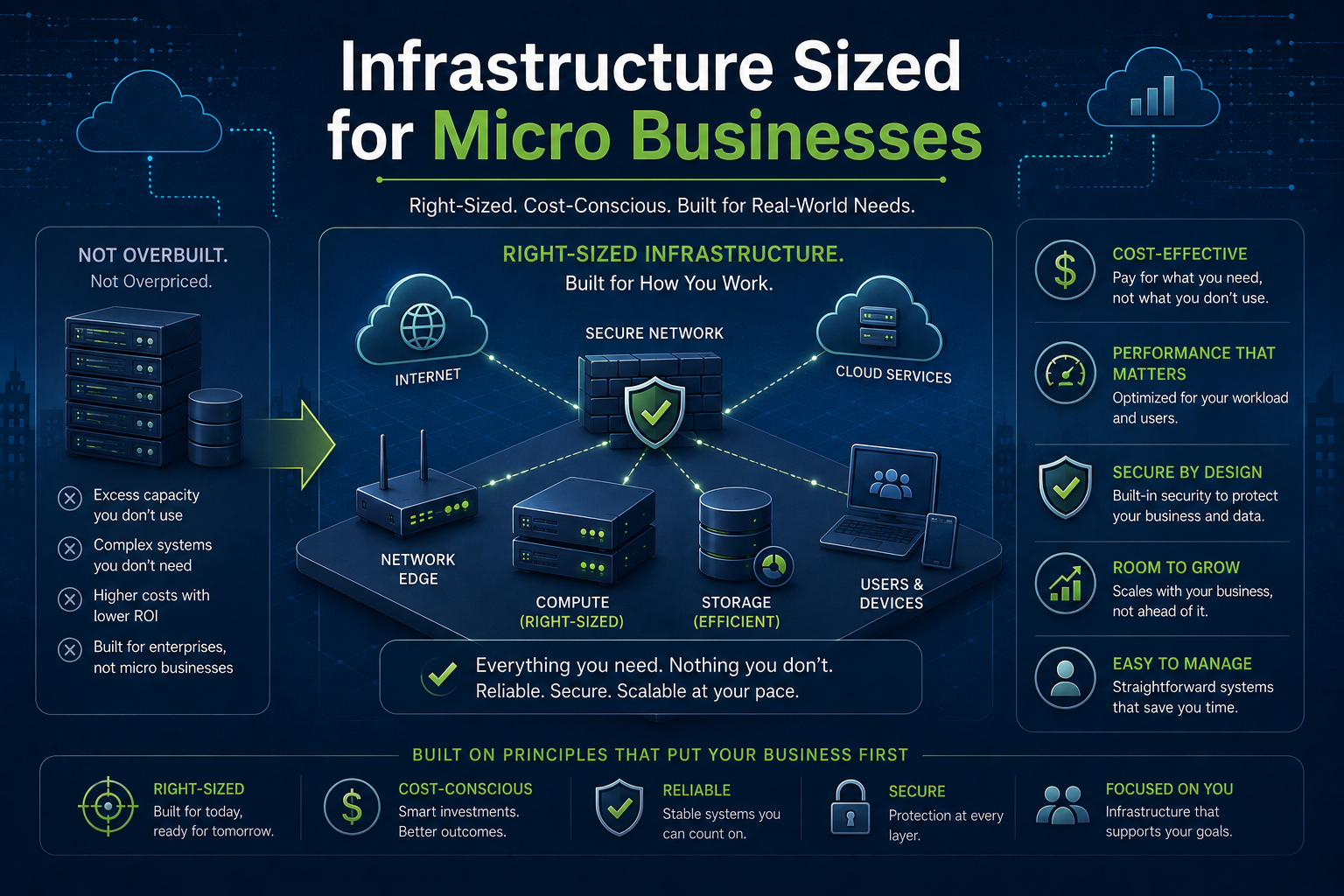
Infrastructure Sized for Real Operational Needs
Get a practical infrastructure review focused on how your business actually operates — not generic MSP bundles or enterprise upselling.
View example costs of a Small Business IT Infrastructure Investment