

Ownership & Exit Strategy
Built for Long-Term Control — Not Long-Term Dependence
Your infrastructure should remain understandable, documented, and transferable — even if your business changes providers, grows internally, or evolves over time.
FOSSnix IT deploys practical Linux-based infrastructure using open standards and client-controlled systems designed to support operational continuity without unnecessary vendor lock-in.
You Should Be Able to Leave
Your IT Provider
Many small businesses discover too late that their systems were never truly theirs to control.
Critical infrastructure ends up tied to:
- proprietary platforms
- MSP-controlled accounts
- undocumented configurations
- subscription lock-in
- inaccessible backups
- vendor-owned domains and DNS
- unmanaged credential sprawl
When the relationship with a provider changes, businesses can suddenly face:
- expensive migration projects
- operational downtime
- loss of access to systems or data
- emergency rebuilds
- difficulty onboarding new technical help
FOSSnix IT is built around a different philosophy:
Your infrastructure should remain operationally understandable, transferable, and owned by you.
Infrastructure Ownership First
The goal is not dependency.
The goal is operational stability and long-term control.
FOSSnix IT builds infrastructure using open standards, documented systems, and client-owned platforms whenever practical. The environment is designed so your organization can:
- retain administrative ownership
- transition to another provider if necessary
- bring management in-house later
- continue operating independently
- avoid unnecessary rebuilds caused by vendor lock-in
That philosophy influences every layer of deployment:
- virtualization
- networking
- storage
- identity
- collaboration systems
- backups
- documentation
- DNS and remote access
What Ownership Actually Means
Administrative Access
Clients retain administrative access to their systems and platforms.
This can include:
- hypervisor access
- firewall administration
- domain and DNS ownership
- cloud account ownership
- backup systems
- VPN infrastructure
- documentation platforms
- monitoring systems
You should never discover that a critical system is tied exclusively to a former provider’s personal account.
Documentation & Transparency
Infrastructure should not operate like a black box.
FOSSnix deployments include documentation covering:
- network layout
- IP addressing
- VLAN structure
- service inventory
- backup policies
- administrative credentials
- hardware inventory
- recovery procedures
- external dependencies
The goal is operational continuity — not obscurity.
Open Standards & Portable Systems
Whenever practical, FOSSnix IT prioritizes:
- Linux-based infrastructure
- open-source platforms
- standard protocols
- portable data formats
- interoperable services
This reduces the risk of:
- forced licensing changes
- abrupt SaaS pricing increases
- proprietary migration barriers
- unsupported legacy dependencies
- platform abandonment
It also makes future transitions significantly easier.
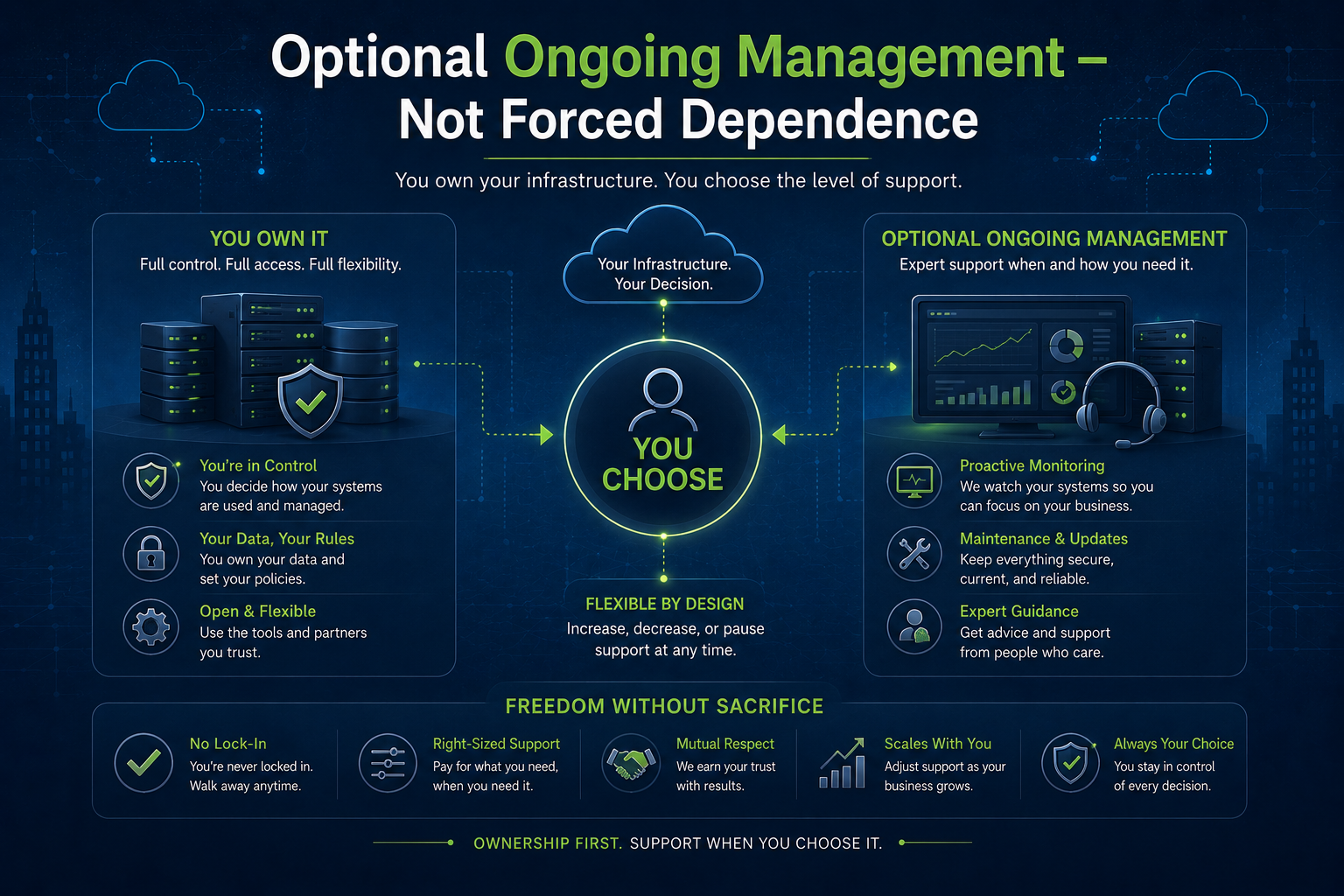
Optional Ongoing Management —
Not Forced Dependence
FOSSnix IT offers ongoing infrastructure management and operational support, but the environment is not designed to trap clients into indefinite dependency.
Organizations may choose to:
- continue managed operations
- transition to internal administration
- use a hybrid support model
- work with another provider in the future
The infrastructure should still remain understandable and maintainable.
Exit Planning Is Part of
Responsible Infrastructure
Very few providers discuss what happens if:
- the engagement ends
- leadership changes
- the company grows internally
- another MSP takes over
- budgets shift
- operations are acquired or merged
FOSSnix IT considers those realities during the initial design process.
A healthy infrastructure environment should survive organizational change.
What a Transition Should Look Like
A properly designed handoff should include:
- administrative credential transfer
- updated documentation
- exportable backups
- service inventories
- architecture diagrams
- DNS and domain ownership verification
- recovery validation
- reasonable operational continuity
Not panic. Not emergency reconstruction. Not discovering your own systems are inaccessible.
Why This Matters for Micro Organizations
Large enterprises usually maintain internal IT ownership and governance processes.
Micro businesses and small organizations are often the most vulnerable to lock-in because:
- technical decisions are outsourced
- documentation is incomplete
- systems evolve organically over time
- vendor relationships become informal
- operational knowledge lives inside one person’s head
That creates long-term operational risk.
FOSSnix IT is designed to reduce that risk by building infrastructure with transparency, portability, and continuity in mind from the beginning.
Build Infrastructure You Can
Actually Control
Reliable infrastructure should strengthen operational independence — not reduce it.
FOSSnix IT helps organizations deploy practical, ownership-first infrastructure designed around:
- long-term control
- operational continuity
- documentation
- portability
- maintainability
Know What You Actually Own
If you are unsure who controls your backups, DNS, infrastructure credentials, cloud accounts, or recovery process, an infrastructure review can help identify operational risks and dependency gaps before they become emergencies.
Understand How Engagements Work